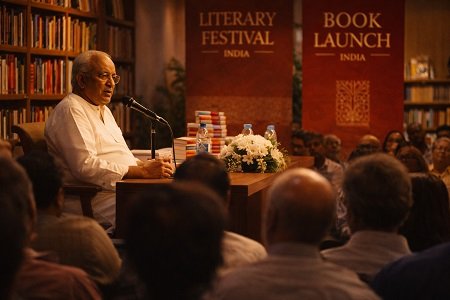
Nobel Peace Prize laureate Kailash Satyarthi has released Karuna: The Power of Compassion, published by HarperCollins India in 2026. The book was pre-launched at the Hyderabad Literary Festival on January 23, 2026, formally inaugurated by Telangana Governor Jishnu Dev Varma on January 24, launched again at the Jaipur Literature Festival in early 2026 — where Satyarthi was in conversation with author Amish Tripathi — and received a New Delhi launch on February 19, 2026, attended by Supreme Court Justice Surya Kant and former IPS officer Dr. Kiran Bedi.
Satyarthi received the Nobel Peace Prize in 2014, sharing it with Malala Yousafzai. He has spent more than five decades working on child rights, and in that time has been directly involved in rescuing more than 1,38,000 children from child labour, trafficking, and exploitation. Karuna is, in part, the book that comes from that experience — an attempt to explain what drove all of it, and to argue that the same force can be applied far beyond social activism.
What the Book Actually Argues
The central claim Satyarthi makes in Karuna is one he has been careful to define precisely: compassion is not an emotion. It is not kindness, pity, sympathy, or empathy. It is not charity. For two thousand years, he argues, these things have been grouped together and the distinctions have been lost. His book attempts to separate them.
In Satyarthi’s framing, compassion is a force born of feeling another person’s suffering as one’s own — and that feeling driving mindful, concrete action. The distinction matters to him because emotions can be passive. You can feel sympathy for someone and do nothing. Compassion, in his definition, cannot remain passive — if it is genuine, it produces action. That is why he calls it a force rather than a feeling.
At the Hyderabad Literary Festival launch, Satyarthi put it plainly: “Compassion is not just an emotion, it is a disciplined and practical force. It can help solve major global problems like human trafficking, social inequality and environmental damage.”
The book draws on the Bhagavad Gita and the Rig Veda, on anecdotes from Satyarthi’s fieldwork across multiple countries, and on conversations with world leaders and ordinary people. It covers the individual dimension — self-compassion, its difficulty, and why most people find it harder than compassion for others — and then scales outward to families, institutions, communities, and finally global systems.
The Compassion Quotient — CQ
The part of the book that has drawn the most public attention is Satyarthi’s introduction of the Compassion Quotient, or CQ. He is deliberate about how it differs from IQ and EQ.
Satyarthi describes IQ and EQ as measuring systems that rank people as superior or inferior. CQ, he argues, works differently — it does not create a hierarchy. Compassion is in everyone, and it is infinite. No person has less capacity for it than another; it only needs to be recognised and exercised.
He also talks about using CQ for practical, measurable purposes — including, in one example, finding compatible partners for marriage. When properly developed with the help of researchers, he suggests marriages could be based on how people respond to shared suffering or are willing to accept each other’s shortcomings, rather than on birth charts, physical appearance, or family connections. He applies the same principle to hiring: CQ as a criterion for evaluating candidates alongside conventional qualification metrics.
The idea of quantifying compassion will be unfamiliar to most readers, and Satyarthi addresses that directly. His argument is not that compassion can be reduced to a number in the way IQ scores work, but that it can be observed, assessed, and deliberately cultivated — which makes it actionable in ways that abstract appeals to kindness are not. Whether the framework becomes a formal tool depends on the research Satyarthi says is underway.
The Nathdwara Temple — One Story From the Book
Satyarthi grounds many of his arguments in specific events from his own life. One that he has shared publicly is the Nathdwara Temple episode from October 2, 1988.
The Shrinathji Temple in Nathdwara, Rajasthan, had for centuries barred Dalits from entering. The main gate carried an inscription explicitly prohibiting entry to untouchables. On October 2, 1988, Satyarthi led a procession from Udaipur to the temple with a group of Dalit friends to offer prayers — a direct act against an entrenched social, religious, and political structure that had gone unchallenged for generations.
He describes this not as a political act but as one driven by compassion — by the inability to accept that another person’s suffering was simply the way things were. That inability to accept, and the action it forced, is the mechanism he is trying to explain in the book.
The First Rescue — and Why He Kept Going
At the Hyderabad Literary Festival launch, Satyarthi spoke about failing the first time he tried to rescue a child from bonded labour. He was beaten up during multiple rescue missions in the years that followed. He kept going anyway. “Compassion, for me, is when you feel other people’s problems, feel their pain and you try to solve it, forcing you to take action,” he said. “This was the force of compassion, not sympathy or empathy.”
The distinction he draws — compassion versus sympathy, action versus feeling — runs through the entire book. The rescue missions are not offered as self-congratulation. They are offered as proof of concept: here is what happens when this force is actually operational in a person’s life.
Technology, AI, and Social Media
Karuna does not stay in the past. Satyarthi addresses artificial intelligence, technology, and social media directly — areas where the question of compassion is newly urgent. At the New Delhi World Book Fair in January 2026, Satyarthi called for greater emphasis on what he described as the “compassion quotient” in public life, education, and workplaces, arguing that empathy must be valued as highly as intelligence in shaping a humane society.
He has also called for regulation of social media, including access by minors, to reduce its negative impact — while noting that on the positive side, it can help spread moral values and build communities. He introduced the Compassion Quotient as an actionable societal force, and emphasised the need for global laws to address online child abuse.
One Amazon reader who first encountered the book at a Jaipur Literature Festival session described it as connecting compassion directly with modern challenges including artificial intelligence and technology — a dimension they had not expected from a book on the subject. That surprise is part of what makes the book different from what its title might lead a reader to expect.
The Oslo Speech — and What the Book Continues
When Satyarthi accepted the Nobel Peace Prize in Oslo in December 2014, he made a call to the world to “globalise compassion.” That speech — delivered to a global audience at one of the most formal stages in public life — was twelve years ago. Karuna is, in a sense, the full argument he did not have time to make in Oslo. The speech was a demand. The book is the reasoning behind it.
Satyarthi believes that when writers, artists, scientists, and innovators are guided by compassion, their work can shape awareness and inspire collective responsibility. The book addresses not just activists or social workers — it is addressed to anyone operating in any field, on the premise that CQ is relevant wherever decisions are made that affect other people. Which is everywhere.
Publication Details
Karuna: The Power of Compassion is published by HarperCollins India, released in 2026 under the Satyarthi Movement for Global Compassion. It is available in print and as a Kindle eBook on Amazon India. The book has been widely reviewed across Indian literary publications following its multi-city launch circuit — Hyderabad, Jaipur, and New Delhi — across January and February 2026.

 celebritiesbuzz