Skincare has followed the same basic formula for years: cleanse, tone, treat, protect, and repeat. Millions of people have made this skincare routine part of their everyday lives, applying serums and creams in the right order, at the right time, every day. Yet for more and more consumers, the results have started to plateau. No matter how disciplined the routine is, the expected glow does not always appear. This has created a quiet but important shift in the beauty and wellness space, moving attention from topical products toward what is now being called daily skin nutrition.
The Ceiling of Topical-Only Routines
A good skincare routine can only do so much. Serums and creams mainly work on the surface, helping hydrate, protect, and address visible concerns such as dullness or uneven skin tone. But skin health is influenced by more than surface care alone. Sleep, stress, diet, and internal oxidative stress can all eventually show up on the skin, regardless of how many products are used.
This is why many people who follow a disciplined external skincare routine still do not see the glow or clarity they are looking for. The skin can reflect something deeper than what is being applied to it, and simply adding more layers of serums cannot replace that.
The Rise of Skin Nutrition
This is exactly where skin supplements have started gaining attention. These products are not meant to replace a skincare routine; instead, they are intended to support it from the inside out by nourishing skin health at the cellular level so that external products have more to work with.
Skin health is not a new concept in wellness circles, but it has only recently started becoming more common in mainstream beauty routines. The idea is straightforward: skin is an organ, and like every other organ, it responds to what the body receives internally, not only to what is applied topically.
Why Consumers Are Making the Shift
There are a couple of reasons behind this change:
The results plateaued. People who have tried several topical products often find that their results eventually stop improving, which encourages them to look inward for the next step.
Growing awareness of antioxidants. Glutathione and other ingredients known for helping reduce oxidative stress and support a more even skin tone are rapidly becoming more familiar beyond dermatology clinics.
Convenience. Taking a daily pill or an effervescent drink can be easier to fit into a busy schedule than following a complicated multi-step skincare regimen.
A holistic mindset. Beauty and wellness are increasingly being viewed as connected rather than as separate categories.
What to Look For in a Skin Supplement
Not every product in this fast-growing category is the same. If you are considering adding a supplement to your daily routine, it helps to check a few important things: Is the active ingredient included in a clinically meaningful dose? Is it combined with ingredients that help support absorption? And does the brand back its claims with real testing rather than relying only on marketing language? As with topical products, quality and sourcing are far more important than packaging.
Pairing Nutrition With Routine, Not Replacing It
The best approach is not about choosing between a skincare routine and supplements — it is about using both. Cleansing, sun protection, and hydration remain the foundation of healthy skin. Supplements simply provide an additional layer of support, helping with areas that topical products cannot address alone.
Where Glutone-A Fits Into This Shift
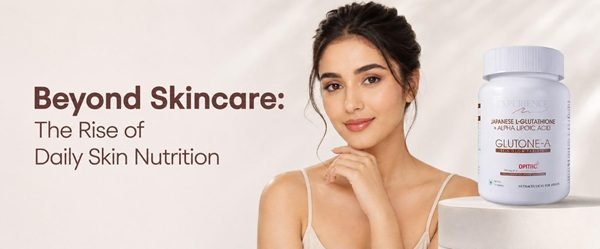
This is where Glutone A fits into the growing focus on daily skin nutrition. Unlike Glutone 1000, Glutone-A is a different skin glow tablet formulated with Japanese Opitac Glutathione and Alpha Lipoic Acid (ALA). The combination provides antioxidant support and is designed to support concerns such as pigmentation, dark spots, tanning, and uneven skin tone from within.
Glutone A Supplements offer consumers an inside-out approach that complements their existing skincare routine. Japanese Opitac Glutathione provides antioxidant support, while Alpha Lipoic Acid (ALA) works alongside it as part of the formulation. Together, these ingredients make Glutone-A a daily skin nutrition option for consumers looking to support skin radiance and a more even-looking skin tone from within.
Additionally, Glutone offers hydration-focused tablets, easy mouth-dissolving melts, and topical products such as face serum and face wash — all designed to enhance, not replace, a consistent skincare routine.
The Next Step in Skincare
Skincare is not going away; it is evolving. As consumers learn more about the factors that truly influence skin health, daily nutrition is becoming almost as routine as applying sunscreen. For many people, the next step in supporting skin glow may not be another serum, but a supplement working quietly in the background, supporting the skin from the inside while topical products continue doing their job on the outside.
The future of skincare is not only about what you apply to your face; it is also about what you put into your body every single day.

 celebritiesbuzz