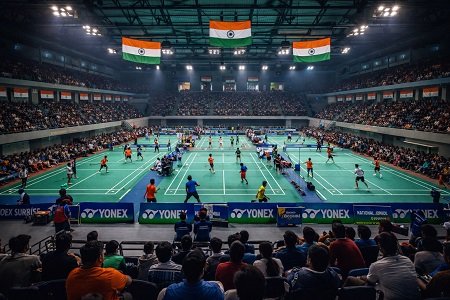
Sikkim has been selected to host the 49th Yonex Sunrise Junior National Badminton Championship (U-19) in November 2026, in what is being described as a first for the state at this level of badminton competition. The tournament is scheduled to run from 14 November to 21 November 2026, and will be organised under the aegis of the Badminton Association of India (BAI). The announcement has placed Sikkim on the national badminton calendar for one of India’s key junior events.
According to reports on the allotment, the event will include individual and team competitions in the under-19 category, bringing together leading junior players from across the country. The championship is part of India’s domestic badminton structure for emerging talent and is expected to feature state units and top young shuttlers competing over a week-long schedule. NewsonAir reported that Sikkim was chosen as the host venue for the prestigious national-level competition, while local coverage in Sikkim described the decision as a landmark moment for badminton in the state.
The headline significance of the decision is that Sikkim will host the championship for the first time. That point has been repeatedly highlighted in reporting around the announcement. For a state that has been steadily trying to expand its sporting footprint, landing the hosting rights for a recognised national badminton event represents a major administrative and sporting milestone. It also means Sikkim will welcome junior players, coaches, officials and support staff from across India for one of the country’s prominent age-group tournaments.
Jacob Khaling, president of the Badminton Association of Sikkim, said the state was proud to have been selected to stage the championship. As reported by NewsonAir, Khaling described the allotment as a matter of pride and thanked Himanta Biswa Sarma, who serves as president of the Badminton Association of India, along with Sanjay Mishra, BAI general secretary, and the executive committee for placing their trust in Sikkim. Those comments underline that the hosting award was not seen merely as a calendar allocation, but as a vote of confidence in the state’s readiness to manage a competition of national importance.
The tournament itself occupies an important place in Indian badminton’s development pipeline. Junior national championships are often closely watched because they bring together many of the country’s strongest teenage players at a time when they are competing for rankings, titles and visibility within the domestic system. The BAI events listing for 2026 shows how extensive the national badminton calendar is, including Yonex-Sunrise All India Junior (U-19) and sub-junior ranking events across different states. Within that broader structure, the Junior National Championship stands out as a flagship age-group event.
The U-19 category is especially important because it sits close to the transition between age-group badminton and the senior circuit. Strong performances at this level often draw national attention and can shape the next stage of a player’s career. India’s badminton system has produced several players who first built recognition through junior tournaments before moving into the senior national and international arena. While the 2026 field has not yet been announced, the championship is expected to showcase many of the country’s most promising young players. This is an inference based on the role junior national championships traditionally play in the BAI competition structure.
For Sikkim, the hosting rights may also have a direct effect on local badminton development. A national event of this scale usually creates a period of focused preparation around courts, logistics, accommodation, technical operations and volunteer support. It can also increase interest among local athletes and younger players, who gain an opportunity to watch top juniors compete at close range. Local reporting has already framed the tournament as a significant boost for the state’s sports landscape, with the expectation that it could raise badminton’s profile and encourage deeper participation.
The organisational challenge will be substantial. A junior national championship requires more than match courts. Hosts need to manage scheduling, accreditation, umpiring and refereeing support, training access, player movement, medical readiness, hospitality arrangements and coordination with participating state associations. Because the championship includes both team and individual sections, event management becomes even more demanding, with multiple draws, match windows and athlete requirements to balance over several days. The schedule reported for 14 to 21 November 2026 suggests a full national meet with a compressed but intensive format.
The event also arrives at a time when India’s badminton system remains deeply competitive at the junior level. Across BAI-recognised tournaments, players from states such as Haryana, Rajasthan, Karnataka, Telangana, Tamil Nadu, Assam and others regularly contend for titles in junior and sub-junior categories. Coverage of recent age-group tournaments shows the spread of competitive talent across the country, with winners and finalists emerging from multiple states. That competitive depth is one reason a junior national championship tends to draw close attention from coaches and selectors.
From a sporting perspective, Sikkim’s role as host will place it in the national spotlight for at least a week in November 2026. Such events often bring increased media visibility for the host state, especially when they mark a first. They can also offer a test of sports administration capacity, because the smooth delivery of a national championship depends on both local planning and coordination with the national federation. In that sense, the 49th edition of the championship will not only be about the players contesting titles, but also about how effectively Sikkim delivers a tournament of this scale. That is a practical inference drawn from how national championships are typically evaluated.
The use of the Yonex Sunrise branding in the championship title also reflects the commercial and sponsorship framework around Indian badminton’s domestic competitions. Sponsorship support is a visible feature of many BAI events and helps structure the tournament calendar across age groups and categories. The championship name as reported in coverage of the Sikkim allotment matches the wider naming pattern seen across other BAI events in 2026, including junior and sub-junior ranking tournaments.
There is also a larger sports-development angle to the story. When a smaller or less frequently spotlighted state hosts a national-level tournament, it can help decentralise the competition map. Instead of major events being concentrated only in India’s biggest sports centres, hosting moves into newer venues and regions. That can widen access, create local experience in event management and encourage broader sporting ecosystems. Sikkim’s selection fits that pattern and may be seen as part of a wider effort to spread national sports events beyond the traditional hubs. This point is an inference based on the significance attached to first-time hosting in the reports.
For the players who will compete, the November 2026 championship is likely to be one of the most important domestic stops of the year. Junior nationals often bring pressure because they gather the best players in one championship environment rather than splitting them across ranking events. Titles at this level carry prestige, and strong performances can influence a player’s standing in the junior circuit. With team and individual events both on the schedule, athletes may also face demanding workloads across consecutive days.
At this stage, the confirmed core facts are straightforward. Sikkim will host the 49th Yonex Sunrise Junior National Badminton Championship (U-19) 2026; the event is scheduled from 14 to 21 November 2026; it will feature individual and team competition; and it is being held under the framework of the Badminton Association of India. For Sikkim, the allotment marks a notable first. For Indian badminton, it adds another important stop on the national junior calendar. And for the country’s young shuttlers, it sets the stage for a major championship week in the eastern Himalayas next November.

 celebritiesbuzz