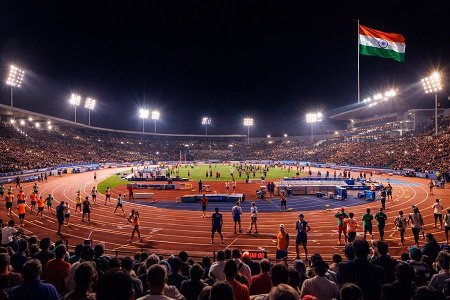
India has been awarded the hosting rights for the 2028 World Athletics Indoor Championships, with Bhubaneswar named as the host city and the event set to be staged at the Kalinga Stadium complex in Odisha. The decision marks a major moment for Indian athletics, as it will be the first time India hosts the World Athletics Indoor Championships. Reports on the award say the decision was taken by the World Athletics Council, and that the event will bring one of track and field’s biggest indoor competitions to Indian soil.
The announcement has been seen as a significant addition to India’s growing list of major international sports events. According to official and widely reported accounts, the championships were awarded to Bhubaneswar after a review of the city’s readiness and the facilities available at Kalinga. The indoor venue at the Kalinga Stadium complex has been highlighted as the centrepiece of the bid, with visiting officials said to have inspected the facilities before the final decision was made.
For Indian athletics, the development is important not only because of the scale of the tournament, but also because indoor athletics has traditionally had a far smaller competitive footprint in the country than outdoor track and field. Recent reports have linked the hosting rights to a broader push to strengthen India’s indoor athletics structure, including the launch of national indoor competitions in Bhubaneswar as part of long-term preparation for 2028.
The World Athletics Indoor Championships is one of the sport’s premier global meets, drawing elite athletes from around the world in events ranging from sprints, middle-distance races and relays to jumps, throws, combined events and pole vault. Unlike outdoor world championships, the indoor edition is staged in a controlled arena setting, which places a premium on specialised facilities, technical readiness, athlete services and event presentation. With the championships now confirmed for Bhubaneswar, India will be expected to prepare not just a venue, but an entire high-performance and event-delivery ecosystem over the next two years.
Bhubaneswar’s selection continues Odisha’s emergence as one of India’s most active sports-hosting states. The city and the wider Kalinga Stadium complex have already built a reputation for staging large competitions across multiple disciplines. In athletics specifically, Bhubaneswar has previously hosted the Asian Athletics Championships, an event that helped establish the city’s credentials in the track and field world. Recent coverage of the 2028 decision has pointed to that history as one reason the city entered the race for the indoor world meet with credibility.
The award is also notable in a broader continental context. Reports have said that with this decision, India becomes only the fourth Asian country to host the World Indoor Athletics Championships. That statistic underlines both the rarity of the event coming to Asia and the importance of India’s successful bid. It places Bhubaneswar in a small group of Asian hosts trusted with one of athletics’ most technically demanding international competitions.
In the days following the announcement, athletics administrators in India described the event as a turning point for the sport domestically. A report on the upcoming national indoor championships quoted Athletics Federation of India president Bahadur Singh Sagoo as saying the meet would “herald a new beginning in Indian athletics,” linking the immediate domestic calendar to India’s long-range preparations for the 2028 global event. That framing suggests the federation sees the championships not as a one-off hosting assignment, but as a chance to build a more durable indoor competition culture in the country.
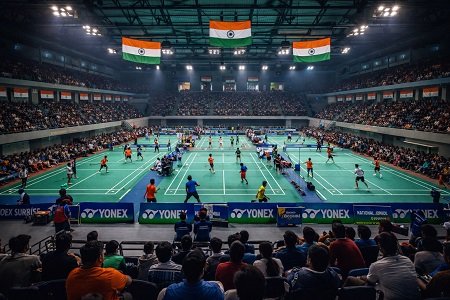
That matters because indoor athletics operates differently from the outdoor circuit. Events are held on shorter tracks, often 200 metres in circumference, with tighter turns, different race dynamics and a more compressed competition environment. For athletes, it demands specialised preparation. For organisers, it requires world-class surfaces, lighting, climate control, broadcast arrangements, warm-up areas, recovery zones, anti-doping infrastructure and precision technical systems for timing and measurement. India’s ability to host the championships will therefore depend not just on the venue’s appearance, but on whether it can meet every competition and operational standard expected by World Athletics.
The Kalinga indoor facility has figured prominently in reporting around the award. Official and federation-linked accounts have described it as a state-of-the-art indoor venue. According to these reports, World Athletics officials visited and inspected the infrastructure before the hosting rights were finalised. That inspection process is a standard part of major event awarding, but in this case it has taken on added significance because it signals that Bhubaneswar’s bid was built around a venue already considered viable at an international level.
For India’s athletes, the tournament may provide one of the strongest home advantages the sport has ever offered at this level. Hosting a world championship means Indian competitors could perform in front of home crowds against leading international athletes without the travel burdens and adjustment challenges that often come with overseas events. It would also give Indian coaches, technical officials and sports administrators direct exposure to global best practices in championship management, athlete support systems and competition standards. These are gains that often outlast the event itself. This is an inference based on how major global meets typically affect host nations, and on the federation’s stated push to grow indoor athletics ahead of 2028.
The timing is also important. The decision comes as India continues trying to deepen its presence in international sport through a combination of infrastructure investment, event hosting and athlete development. In recent years, Indian sport has increasingly placed emphasis on securing major events as a way to boost visibility, improve facilities and create pathways for elite competition at home. The awarding of the 2028 indoor championships fits squarely into that strategy. Reports from official and sports bodies have presented the decision as both an honour and a responsibility.
The championships are expected to attract athletes, coaches, officials, media teams, sponsors and supporters from dozens of countries. Although detailed participation numbers for 2028 have not yet been released, the event traditionally draws a large international field and extensive broadcast attention. That scale means Bhubaneswar will need to prepare well beyond the arena itself: transport planning, hotel capacity, security, city logistics, accreditation, volunteer management and medical readiness will all form part of the delivery challenge. Those details are usually developed closer to the event, but the planning window begins much earlier.
The host city is also likely to see economic and visibility gains. Major international championships can produce short-term boosts in hotel occupancy, local transport demand, hospitality activity and service employment. They can also produce long-term branding benefits if the event is delivered smoothly and broadcast globally. For Bhubaneswar, which has steadily built an identity around sports infrastructure and event hosting, the 2028 championships offer another opportunity to reinforce that image on a world stage. Recent media reports have repeatedly connected the city’s selection to Odisha’s wider sports strategy.
The road from announcement to opening ceremony, however, will be closely watched. Once a championship is awarded, attention shifts quickly from celebration to execution. Upgrades, test events, technical certification, staffing and athlete-preparation programmes all have to move in step. In that sense, the next two years may be as important as the event itself. India’s early moves appear to reflect that reality: reports say the inaugural National Indoor Athletics Championships in Bhubaneswar are being positioned as a first major step in creating a domestic base for the 2028 build-up.
There is also symbolic value in the decision. India has hosted major events in several sports, but athletics retains a special place because of its status as one of the oldest and most universal competitive disciplines. To host a world athletics championship is to host a sport that sits at the core of the Olympic movement. Even though this is the indoor edition, the prestige remains considerable. The event will bring some of the biggest names in track and field to India, and recent coverage has already pointed to the possibility that globally recognised stars could compete in Bhubaneswar in 2028.
For Odisha, the announcement is another validation of a sports policy that has consistently backed infrastructure and hosting. For Indian athletics, it is an opportunity to convert visibility into structure. And for fans, it means that in 2028, one of the sport’s major global championships will unfold at home, with Bhubaneswar at the centre of the action.
At this stage, the essential facts are clear: India will host the 2028 World Athletics Indoor Championships, Bhubaneswar has been named the host city, and the event will take place at the Kalinga Stadium complex. It is a first for the country, a milestone for Indian athletics and a major assignment for organisers in Odisha and beyond. The years ahead will determine how fully India can turn that opportunity into a lasting sporting legacy.
 celebritiesbuzz