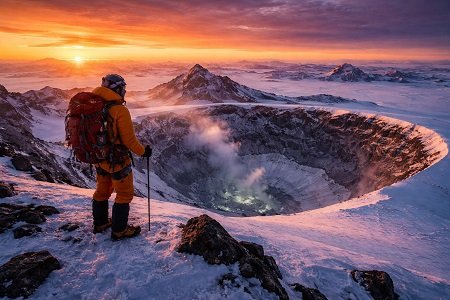
Bhupathiraju Anmish Varma from Visakhapatnam, Andhra Pradesh, has entered the Guinness World Records as the fastest person to climb the Seven Volcanic Summits — the highest volcanoes on each of the seven continents. He completed the challenge in 92 days, 4 hours, and 45 minutes, starting on October 23, 2024, at Mount Elbrus in Russia, and finishing on January 23, 2025, at Mount Sidley in Antarctica. The record was officially recognised by Guinness World Records on February 6, 2026. Varma received his certificate at a formal ceremony at CSOI, Vinay Marg, New Delhi, on the evening of March 17, 2026, where Rishi Nath from the Guinness World Records team made the presentation.
Guinness World Records posted the official announcement on its X account on March 19, 2026: “Fastest time to climb the seven volcanic summits (male): 92 days 4 hours and 45 minutes by Bhupathiraju Anmish Varma.” The post carried the Indian flag alongside his name.
What the Seven Volcanic Summits Challenge Actually Involves
The Seven Volcanic Summits are the highest volcanoes on each continent. They are not the same as the Seven Summits — the most famous mountaineering challenge, which targets the highest peak on each continent regardless of volcanic origin. The volcanic version is a distinct, and in some ways more obscure, challenge. The seven peaks Varma climbed are Mount Elbrus in Russia (Europe), Mount Damavand in Iran (Asia), Pico de Orizaba in Mexico (North America), Ojos del Salado on the Chile-Argentina border (South America), Mount Kilimanjaro in Tanzania (Africa), Mount Giluwe in Papua New Guinea (Oceania), and Mount Sidley in Antarctica.
Each of these sits on a different continent, in a different climate, at a different altitude, and with its own set of logistical demands. Getting from one to the next requires not just physical recovery but international travel, permit applications, weather windows, and equipment reconfiguration for entirely different conditions — from the extreme cold of Antarctica at Mount Sidley, which sits at 4,285 metres on the Ellsworth Mountains, to the thin dry air of Ojos del Salado at 6,893 metres on the Andes, the highest active volcano in the world.
Completing all seven in under 93 days means Varma had almost no margin for weather delays, permit holdups, or recovery time between climbs. The 92-day window, from Elbrus on October 23 to Sidley on January 23, covers the southern hemisphere summer — the only viable window for an Antarctic summit — which constrains the entire sequence. It is not simply a matter of climbing fast. The logistics have to work precisely, continent by continent, for the clock to come in at under three months.
The Route — Continent by Continent
Varma began in Russia. Mount Elbrus (5,642 metres) in the Caucasus is Europe’s highest peak and its highest volcano. It is technically accessible but can be brutal in high winds and whiteout conditions. From there, the challenge moved to Mount Damavand (5,610 metres) in Iran — a dormant stratovolcano in the Alborz range north of Tehran and Asia’s highest volcano. Damavand’s high-altitude sulphur vents and unpredictable weather make it harder than its altitude alone suggests.
Pico de Orizaba (5,636 metres) in Mexico, North America’s highest volcano and third-highest peak overall, came next. Then Ojos del Salado (6,893 metres) on the Chile-Argentina border — the highest active volcano on earth, sitting in one of the driest high-altitude environments anywhere. The Atacama approach requires acclimatisation at altitude before any summit attempt is viable.
Mount Kilimanjaro (5,895 metres) in Tanzania is Africa’s highest peak. It sees more climbers than most of the others on this list, but altitude sickness is common among those who ascend too fast. Mount Giluwe (4,367 metres) in Papua New Guinea is the least well-known of the seven — a broad shield volcano in the Southern Highlands, remote and rarely attempted by international climbers. And finally, Mount Sidley (4,285 metres) in Antarctica — the continent’s highest volcano and one of the most logistically demanding summits on earth, accessible only during the short Antarctic summer and requiring transport via a private expedition flight to a base camp on the ice sheet.
From Karate to Kilimanjaro — The Background
Varma was born on November 4, 1992, in Visakhapatnam. He is an MBA graduate from the Institute of Technology and Sciences, Visakhapatnam — a detail that tends to get buried under the mountaineering record but is worth noting. He did not start his career as a climber. He started in martial arts.
He is a multiple world karate and kickboxing champion — gold at the World Martial Arts Championship in Athens in 2018, gold in Vienna in 2019, and gold in Canada in 2023. He credits the discipline, mental toughness, and physical conditioning from years of competitive martial arts as the foundation for what he has achieved at altitude. That transition from dojo to summit is not common in mountaineering, where most elite climbers come up through traditional alpine or trekking routes.
His mountaineering record before the Seven Volcanic Summits record was already substantial. He summited Mount Everest in 2021 — during one of the more difficult seasons, with two cyclones affecting the Himalayan ranges during the climbing window. He has climbed Mount Aconcagua (South America’s highest) in 2020, Mount Kilimanjaro in 2020, Mount Elbrus in 2021, and Mount Denali (North America’s highest) in 2022. He has also skied to the South Pole — a separate expedition requiring a 111-kilometre ski traverse across the Antarctic ice sheet from a drop-off point to the geographic South Pole. That combination of Everest, Seven Summits, South Pole ski, and now the Seven Volcanic Summits record puts him in a very small global group of adventure athletes.
He has received the Best Sportsperson Award from both the Government of Andhra Pradesh (2019) and the Government of Puducherry (2019). During one of his earlier expeditions, a teammate was injured and Varma turned back from a summit to ensure the person was safe — forfeiting a climb he had trained for. He has spoken about that decision in interviews, framing it simply: the summit could wait, a person’s safety could not.
The Certificate Ceremony — March 17, New Delhi
The official Guinness World Records certificate presentation on March 17, 2026 at CSOI, Vinay Marg, New Delhi, was a formal, attended event — not a social media post or a mailed certificate. Rishi Nath from the Guinness team presented it in person. Varma’s Instagram account, which has 82,000 followers, documented the moment. The Guinness X post followed two days later on March 19, which is when the record reached wide public attention in India.
The record is listed specifically in the male category: Fastest time to climb the Seven Volcanic Summits (male). That qualifier exists because Guinness maintains separate records for male and female climbers in speed-based mountaineering categories. Varma holds the men’s record as of the official recognition date.
92 Days
Ninety-two days is a number worth sitting with for a moment. From October 23 to January 23, crossing seven continents, seven volcanoes, altitudes ranging from 4,285 to 6,893 metres, temperatures from the Iranian plateau to the Antarctic ice sheet, with travel, acclimatisation, permits, and weather factored in. Three months, almost to the day. For context, most expedition teams take anywhere from two to four weeks on a single one of these peaks.
Varma did all seven, back to back, in under a season. That is what the record reflects. Not just the climbing. The whole thing — the planning, the logistics, the physical output, and the time between. Guinness does not certify effort. It certifies the clock. The clock said 92 days, 4 hours, and 45 minutes. That is the number now in the record books.
 celebritiesbuzz