Jharkhand celebrated Sarhul on March 21, 2026 — the most significant festival in the tribal calendar of the state. Streets in Ranchi, Gumla, Khunti, Simdega, and Lohardaga filled with processions, drum beats, and people in traditional dress. The festival, which marks the tribal new year and the arrival of spring, has been observed across the Chhotanagpur plateau region for over 2,000 years. This year, like every year, it came on the third day of the waxing moon in the Hindu month of Chaitra.
Chief Minister Hemant Soren performed traditional rituals at the Sarna site in Sirmtoli, Ranchi. His wife and legislator Kalpana Soren was also present. The Jharkhand government declared a two-day state public holiday to allow full participation in the celebrations — a recognition of how deep the festival runs across the state’s population, not just in villages but in urban Ranchi too.
What Sarhul Actually Is
The word Sarhul breaks down simply. Sar means the Sal tree — Shorea robusta, the dominant timber tree of Jharkhand’s forests — and hul means worship, or collectively, or grove, depending on the tribe. Some interpret it as sar meaning year and hul meaning beginning. Either way, the festival is about two things at once: worshipping the Sal tree and starting the new year. For Jharkhand’s tribal communities, those two things are not separate.
The Sal tree is the most important source of timber in the region. Its leaves are shaped into bowls used during ritual offerings. When the Sal flowers in early spring — white clusters appearing on bare branches — it signals the change of season and triggers the festival. The tree is also considered the abode of the goddess Sarna, who protects the village. So when it flowers, it is not just an agricultural signal. It is a religious one.
Sarhul is primarily celebrated by four tribes: the Oraon, the Munda, the Ho, and the Santals. The Santals call it the festival of flowers. In the Kolhan region, it goes by the name Baa Porob. Different names, same roots. Non-tribal residents of Jharkhand have increasingly joined the celebrations over the years, and the festival is now observed at schools, colleges, and government offices across the state.
The Pahan and the Rituals That Open the Festival
The rituals are led by the Pahan — the village priest — and his assistant, the Pujar. The night before the festival, the Pahan fasts. He takes three new earthen pots, fills them with fresh water from the river, and places them under the Sal tree overnight. The next morning, he reads the water levels.
If the water level has dropped, the Pahan predicts poor monsoon rainfall or possible famine in the year ahead. If the level holds normal, it signals good rains and a productive agricultural season. This tradition has been carried out in the same way for generations. It sits somewhere between ritual and weather forecasting, and for farming communities whose entire livelihood depends on the monsoon, it is taken seriously.
Before the puja begins, the Pahan’s wife washes his feet. He then performs the main rituals at the Sarna Sthal — the sacred grove — offering Sal flowers, fruits, and three roosters of different colours to Singbonga, the supreme deity of the Mundas and Ho, also called Dharmesh. After the offering, Sal flowers and handia — a rice beer fermented from rice — are distributed to the entire village. Ploughing and agricultural work are forbidden on the day of the festival. The Pahan completes the rituals first; farming restarts after.
One other ritual stands out: the Pahan places Sal flowers on the roof of every home in the village. This is called phool khonsi — the placing of flowers. It extends the blessing of the Sal tree to each household individually, not just to the community as a whole.
The Processions: What the Streets Look Like on Sarhul
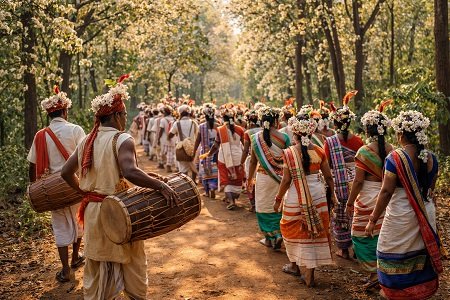
Once the rituals at the Sarna Sthal are done, the festival moves into the streets. Men, women, and children dress in traditional tribal attire — hand-woven fabrics, headdresses of Sal leaves and flowers, anklets, and beads. The colours are specific and worn with intention, not just decoration.
Processions move through town to the beats of dhol (a barrel drum), nagara (a large kettle drum), and mandar (a clay drum played with both hands). Flutes accompany the drums. The sound carries far. In Ranchi, since 1961, these processions have been a formal part of the urban celebration — before that, the dancing stayed near the Sarna Sthal itself. The shift to street processions was part of a broader reimagining of Sarhul as a marker of tribal regional identity, not just a village ritual.
Two dance forms feature prominently: Paika and Chhau. Paika is a martial dance form originally associated with warrior training. Chhau uses elaborate masks and dramatic, acrobatic movement. Both require years of practice. During Sarhul, they are performed in public, on open ground, with full costumes.
Participants smear turmeric and vermillion on each other during the processions. Young men and women collect Sal flowers from the nearby forest in the days before the festival. The flowers are central to almost every aspect of Sarhul — they are offered at the Sarna Sthal, placed on rooftops, worn in hair, and carried in procession.
The Food
Sarhul has a specific food culture tied directly to the season and the forest. Handia — fermented rice beer — is the central communal drink, shared as a symbol of unity after the Pahan distributes the first round as prasad. Beyond handia, the festival table includes mahua laddoo, a sweet made from mahua flowers; dubki, a lentil preparation; bamboo shoot curry; fish sukha, a dried or baked fish dish; and dishes made from mushrooms, seeds, and forest leaves available in early spring. Meat dishes — chicken and mutton — are also part of the feast.
All food prepared during Sarhul is first offered to the deities before it is eaten. The meal is not just about eating. The specific ingredients — forest fruits, spring vegetables, new-season fish — are chosen because they reflect what the land is producing at that exact moment in the year. That is the point.
The Environmental Thread Running Through the Festival
Planting Sal tree saplings is one of the closing acts of Sarhul. Families and community groups plant them near the Sarna Sthal and along village paths as an act of gratitude to the forest. The tribe’s relationship with the Sal tree is not symbolic in an abstract sense — the tree provides timber, leaf plates, flowers for ritual, and shade. Protecting it is practical as much as spiritual.
Chief Minister Hemant Soren, at the Sirmtoli Sarna site, noted that the festival carries a clear environmental message and that the state government is committed to protecting the forest resources that underpin the tribal way of life in Jharkhand. The Jharkhand government’s official position on tribal land rights and forest access has been a recurring political issue in the state, and Soren has consistently framed Sarhul as a reminder of that ongoing commitment.
Unmarried Girls and the Jawa Festival
Running alongside the main Sarhul celebrations is a parallel ritual observed by unmarried girls — the Jawa festival. Young women decorate small baskets with germinating seeds, offer green melons to the Karam deity, and perform their own set of songs and dances. The Jawa ritual is tied to agricultural fertility — good germination of grains — and to the expectation of children. It runs most visibly in the Bundu, Tamar, and Raidih belt of Jharkhand, an area with a deep connection to both tribal traditions and the independence movement.
Sarhul 2026 in Numbers and Reach
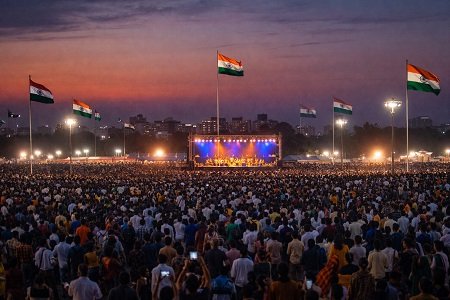
The celebration this year was a full state holiday across Jharkhand — two days, not one. The districts with the largest turnout were Ranchi, Gumla, Khunti, Simdega, and Lohardaga, all of which have dense tribal populations and established Sarna Sthals at the centre of community life. Processions in Ranchi ran through the main city roads, with participation from educational institutions, social organisations, and local governing bodies alongside the tribal communities themselves.
Sarhul is not listed as a national holiday, but within Jharkhand, it functions as one. It is the day the state stops, steps into traditional dress, and processes through the streets behind the sound of drums. That has been true since at least 1961 in the cities, and for far longer in the villages. In 2026, it remains exactly what it has always been — the Sal tree flowers, the Pahan reads the water, and the new year begins.

 celebritiesbuzz