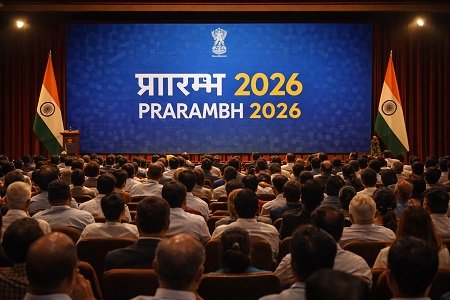
Finance Minister Nirmala Sitharaman launched PRARAMBH 2026 on March 20, 2026, in New Delhi — a nationwide multimedia awareness campaign by the Income Tax Department ahead of the Income Tax Act, 2025, coming into force on April 1, 2026. The new Act replaces the Income Tax Act of 1961, which has been the backbone of India’s direct tax law for 64 years.
PRARAMBH is an acronym for Policy Reform and Responsible Action for Mission Viksit Bharat. The campaign runs across print, radio, television, outdoor hoardings, digital platforms, and social media. Its stated purpose is straightforward: make sure taxpayers — individuals, salaried employees, small business owners, chartered accountants, and corporates alike — understand what has changed before it takes effect.
The launch was attended by Revenue Secretary Arvind Shrivastava, CBDT Chairman Ravi Agrawal, and CBIC Chairman Vivek Chaturvedi. Both direct and indirect tax systems are being overhauled at the same time — something that has not happened before in independent India.
What the New Income Tax Act Actually Changes
The 1961 Act had accumulated over 800 sections spread across 47 chapters over six decades of amendments, additions, and judicial interpretations. The Income Tax Act, 2025 brings that down to 536 sections in 23 chapters. The reduction is not just cosmetic — the intent is to strip out redundant provisions, resolve contradictions that had become permanent sources of litigation, and write the law in clearer language that a taxpayer can read without a lawyer on standby.
One of the more practical changes is the consolidation of the “Previous Year” and “Assessment Year” concepts — long a source of confusion for first-time filers — into a single term: Tax Year. From April 1, 2026, the tax year runs from April 1 to March 31, starting with Tax Year 2026-27. For new businesses, the tax year begins from the date of setup. This alone removes a terminology gap that has tripped up taxpayers for decades.
The new Default Tax Regime under Section 202 makes the simplified tax structure permanent. Taxpayers earning up to ₹12 lakh annually effectively pay zero income tax under this regime due to applicable rebates. The standard deduction for salaried individuals has been raised to ₹75,000. TDS provisions, previously scattered across multiple sections, are consolidated under a single section — simplifying compliance for employers and businesses that deduct tax at source.
What PRARAMBH 2026 Includes
The campaign is not just a press release. Over 300 workshops are being conducted across the country for tax officials, chartered accountants, trade associations, and industry bodies. These are designed both to disseminate information and to collect stakeholder feedback — a recognition that implementation problems surface at ground level, not in ministry meeting rooms.
Guidance materials — notes, tutorial videos, and brochures — have been released in more than 10 regional languages alongside Hindi and English. The multilingual push addresses a real gap: a significant portion of India’s taxpayer base operates in languages other than Hindi, and tax communication in India has historically defaulted to either English or Hindi with limited reach beyond those two.
A MyGov quiz has been launched as part of the public engagement component, aimed at drawing in citizens who may not attend workshops but engage with government platforms online.
Kar Saathi: The AI Chatbot for Tax Queries
Among the new tools launched alongside PRARAMBH 2026 is Kar Saathi — an AI-enabled chatbot on the Income Tax portal that handles tax queries in real time across 12 Indian languages, 24 hours a day. The name translates roughly to “tax companion.” It is designed to reduce the load on helplines and tax offices during the transition period, when query volumes are expected to spike as taxpayers try to understand how the new rules apply to their specific situations.
Kar Saathi operates within the M.A.N.A.V. framework — Moral systems, Accountable governance, National sovereignty, Accessible AI, Valid systems — which the department describes as a human-centric approach to deploying technology in public service. Whether it delivers on that in practice will be seen once the Act comes into force and actual filing cycles begin.
Income Tax Website 2.0
Sitharaman also inaugurated Income Tax Website 2.0 at the PRARAMBH launch. The upgraded portal promises faster processing, simpler navigation, and expanded faceless services — where interactions between the department and the taxpayer happen digitally without any physical interface. The faceless assessment and appeal system, introduced in phases from 2020 onwards, has been one of the more tangible shifts in how the department operates. Website 2.0 is designed to extend that approach further.
The Enforcement Shift — From Compliance to Trust
At the launch, Sitharaman was pointed about the philosophy behind the new Act. She described the approach as a move away from enforcement-driven tax administration toward trust-based engagement. Her framing was direct: the new Act is built for honest taxpayers, with technology and data analytics deployed to catch evasion rather than to create friction for compliant filers.
CBDT Chairman Ravi Agrawal echoed this at the launch, saying PRARAMBH is guided by the spirit of Nagrik Devo Bhava — the citizen is like a deity — and that the Income Tax Act, 2025, must be implemented in a smooth and taxpayer-friendly manner. Revenue Secretary Arvind Shrivastava described the campaign as the beginning of a more open and responsive tax ecosystem, not a one-way government broadcast but an ongoing dialogue with the public.
Whether the tone holds once the new system is fully operational is a different question. What is measurable right now is the structural change: fewer sections, clearer language, a single tax year, consolidated TDS, and a default regime that makes zero-tax filing straightforward for a large slice of the earning population.
April 1, 2026
The Income Tax Act, 2025 takes effect on April 1, 2026 — the start of Tax Year 2026-27. From that date, all assessments, filings, deductions, and proceedings will be governed by the new Act. The 1961 Act, which survived 64 years and hundreds of amendments, will cease to apply to new tax years from that point forward.
PRARAMBH 2026 runs until that date and is expected to continue in some form through the first filing cycle under the new law. For taxpayers who have not yet gone through the new provisions, the Income Tax portal, the Kar Saathi chatbot, and the workshop network are the three primary resources the department is pointing people toward before April 1.

 celebritiesbuzz