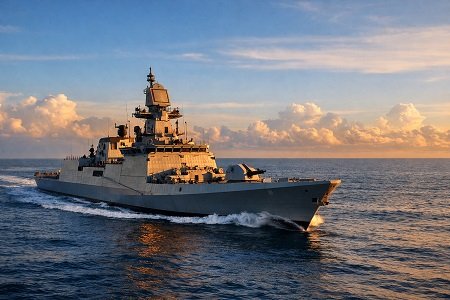
The Indian Navy is set to commission its latest warship, INS Taragiri (F41), on April 3, 2026, in Visakhapatnam. Defence Minister Rajnath Singh will preside over the ceremony. Taragiri is the fourth frigate under Project 17A — the Navy’s ongoing programme to build a class of seven advanced stealth frigates entirely within India.
The ship was built by Mazagon Dock Shipbuilders Limited (MDL) at its Mumbai facility and handed over to the Navy on November 28, 2025. The months between delivery and the commissioning date were used for final crew training, sea trials, and systems checks. On April 3, she formally enters active service.
What Kind of Ship Is INS Taragiri?
Taragiri displaces 6,670 tonnes and is classified as a guided-missile stealth frigate. The hull geometry and angled superstructure are designed to scatter radar signals rather than return them, giving the ship a significantly reduced radar cross-section compared to older Indian Navy surface combatants. The practical result: it is harder to detect on enemy radar at sea.
Propulsion is handled by a Combined Diesel or Gas (CODOG) system — diesel engines for routine cruising, gas turbines when speed is needed. This arrangement is common in modern frigates because it balances fuel economy on long patrols with the burst performance required in combat or emergency situations.
On board, an Integrated Platform Management System (IPMS) keeps track of propulsion, power distribution, and damage control from a centralised network. It reduces the crew workload needed to run the ship and improves response time when systems need attention.
Weapons and Combat Capability
INS Taragiri is armed with BrahMos supersonic cruise missiles. BrahMos, developed jointly by India and Russia, travels at approximately Mach 2.8 to Mach 3 and has an operational range of around 290 kilometres in its naval variant. It is already deployed on several other Indian Navy surface ships and is one of the faster anti-ship missiles in service anywhere in the world.
Beyond BrahMos, the ship carries medium-range surface-to-air missiles for fleet air defence and a dedicated anti-submarine warfare suite — torpedoes, sonar systems, and provision for helicopter operations — covering the underwater threat dimension. Taragiri is, in that sense, a multi-role platform. It does not specialise in one type of warfare at the cost of another.
Project 17A: The Bigger Picture
Project 17A was conceived as a follow-on to the three Shivalik-class (Project 17) frigates commissioned between 2010 and 2012. The Shivaliks were themselves a step forward in indigenous naval shipbuilding. Project 17A went further — deeper indigenous content, better stealth, higher automation, and a Warship Design Bureau (WDB) design rather than a licensed foreign one.
Seven ships make up the full class. Four are being built at MDL in Mumbai; three at Garden Reach Shipbuilders and Engineers (GRSE) in Kolkata. The first ship of the class, INS Nilgiri, has already been commissioned and is currently participating in Exercise Kakadu 2026 off the coast of Australia — a multinational Indo-Pacific naval exercise focused on interoperability. INS Himgiri and INS Udaygiri have also been launched. Taragiri is the fourth.
The remaining three hulls at GRSE are at various stages of construction and are expected to be inducted over the next few years, completing the full seven-ship class.
Indigenous Content and the Industrial Chain Behind the Ship
Over 75% of INS Taragiri’s components are of Indian origin, produced across a supply chain that includes more than 200 micro, small, and medium enterprises (MSMEs). That number — 200-plus suppliers — is not just a procurement statistic. It means the ship’s build has involved specialised Indian firms producing alloys, sensors, electronic systems, propulsion sub-components, and structural materials at the required precision and scale.
Each Project 17A ship commissioned deepens that industrial capacity. Firms that supplied parts for Nilgiri are now more experienced and better equipped to supply parts for Taragiri and the ships that follow. Defence Minister Rajnath Singh has pointed to this as the intended outcome of Aatmanirbhar Bharat in the defence sector — not just one ship built domestically, but a permanent shift in the country’s manufacturing base.
Strategic Context
The Indian Ocean Region has seen a steady increase in naval activity from multiple countries over the past decade, and the Indian Navy has responded by expanding both its presence and its operational tempo. Recent years have seen Indian warships conducting anti-piracy operations in the Gulf of Aden, providing disaster relief in the Maldives and Sri Lanka, and participating in multilateral exercises from the Mediterranean to the Pacific.
Adding a ship of Taragiri’s capability to the fleet at this point matters. The Navy is not just growing in number — the quality and range of what each new ship brings has changed substantially from what was available even fifteen years ago. INS Taragiri, with its BrahMos armament, stealth design, and anti-submarine capability, can operate independently or as part of a larger task group across long distances without the need for constant shore support.
The ship also carries a humanitarian assistance and disaster relief (HADR) capability, in keeping with how the Indian Navy has increasingly used frontline warships during regional crises. The Indian Ocean is one of the most cyclone-prone maritime regions on earth, and a combat-ready ship that can also evacuate civilians or deliver relief supplies covers a much wider spectrum of national requirements.
The Name
INS Taragiri is not a new name in the Indian Navy. The first INS Taragiri was a Leander-class anti-submarine frigate commissioned in 1976 and decommissioned in 2003. It served for nearly three decades, including during the 1971 Indo-Pakistani War, and earned a record of operational service across the Western and Eastern naval commands. The new Taragiri inherits that name and, at 6,670 tonnes with its current weapons and sensor fit, carries it into a different era entirely.
The name follows the Project 17A tradition — all ships in the class are named after mountain ranges or peaks in India. Nilgiri, Himgiri, Udaygiri, Taragiri — each references the subcontinent’s geography, a naming convention the Indian Navy has followed for this class since the original Leander-class frigates of the 1970s and 1980s.
April 3, 2026
The commissioning ceremony at Visakhapatnam will be attended by senior naval officers, government officials, and representatives from MDL. With Taragiri’s induction, the Indian Navy will have four of the seven Project 17A frigates in service or near-service. The remaining three are under construction at GRSE and are expected to complete the class within the next several years.
Taragiri’s entry into service brings the total number of frontline destroyers and frigates in the Indian Navy to a level the service has been working toward for some time — enough ships to maintain sustained deployments across the Indian Ocean while keeping a ready reserve for contingencies in both the Western and Eastern naval theatres.

 celebritiesbuzz